Wednesday, August 14, 2013

Alstonia scholaris


Alstonia scholaris
(Apocynaceae, commonly called Blackboard tree, Indian devil tree, Ditabark, Milkwood pine, White cheesewood and Pulai; syn. Echites scholaris L. Mant., Pala scholaris L. Roberty) is an evergreen, tropical tree native to the Indian subcontinent and Indomalaya, Malesia and Australasia.


Leaves and flowers in Kolkata, West Bengal, India


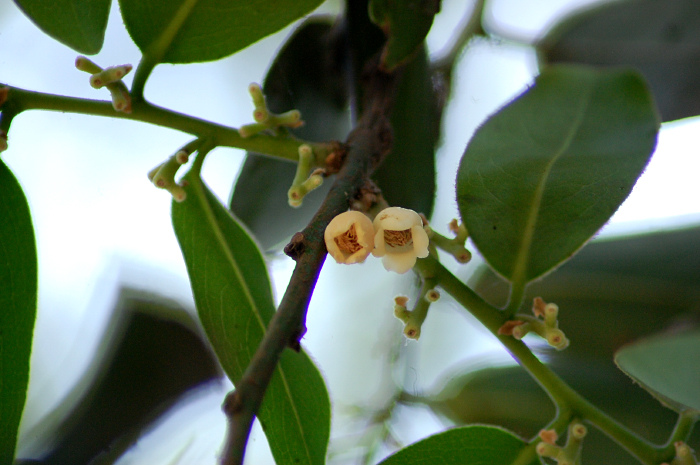
Alstonia scholaris is a small tree that grows up to 40 m tall and is glabrous. The bark is greyish; branchlets are copiously lenticellate.

The upperside of the leaves are glossy, while the underside is greyish. Leaves occur in whorls of 3-10; petioles are 1–3 cm; the leathery leaves are narrowly obovate to very narrowly spathulate, base cuneate, apex usually rounded; lateral veins occur in 25-50 pairs, at 80-90° to midvein. Cymes are dense and pubescent; peduncle is 4–7 cm long. Pedicels are usually as long as or shorter than calyx. The corolla is white and tube-like, 6–10 mm; lobes are broadly ovate or broadly obovate, 2-4.5 mm, overlapping to the left. The ovaries are distinct and pubescent. The follicles are distinct and linear.

Flowers bloom in the month October. The flowers are very fragrant similar to the flower of Cestrum nocturnum.

Seeds of A. scholaris are oblong, with ciliated margins, and ends with tufts of hairs 1.5–2 cm.  The bark is almost odourless and very bitter, with abundant bitter and milky sap.

File:Alstonia scholaris.jpg

Tuesday, August 13, 2013

Dipterocarpus alatus

Dipterocarpus alatus (Thai: ยางนา Yang-Na ) is a tropical forest tree, of dense evergreen or mixed dense forests, common in Thailand, Cambodia, Laos and Vietnam. It often occurs gregariously along river banks and is a key planting species for regenerating deforested land around the Dong Nai river and Cat Tien National Park. This tree is an endangered species in its natural habitat.

In Cambodia the wood is much valued in construction and cabinetwork, when not exploited for its oily resin. Generally, resin is collected for the following uses: wood lacquering, draught-proofing of boats and traditional medicine. When mixed with beeswax, it is used in bandages for ulcerated wounds. The bark of young trees is also used in traditional medicine, taken against rheumatism and diseases of the liver, and to stimulate appetite in cattle.

In Thailand around Big-Mountain (Khow-Yai) Pak Chong district, Nakhon Ratchasima province

Dipterocarpus alatus


Diospyros malabarica

The Gaub Tree, Malabar ebony, Black-and-white Ebony or Pale Moon Ebony (Diospyros malabarica)  is a species of flowering tree in the family Ebenaceae that is native to the Indian Subcontinent and South East Asia.

It is a long lived, very slow growing tree, which can reach up to 35 m in height with a black trunk up to 70 cm in diameter. It is not attacked by insects. It is the provincial tree of Ang Thong Province in Thailand.


The fruits are round, yellow when ripe. It may be somewhat often astringent, even when ripe.

Both the bark of the tree and the unripe fruit have medicinal uses in Ayurveda. Unripe leaves and fruits were traditionally used to dye cloth black. The tree exudes a glutinous substance used for caulking and sealing boats in the traditional way. The unripe fruit is rich in tannins and used for curing nets, leather etc.

Cochlospermum religiosum

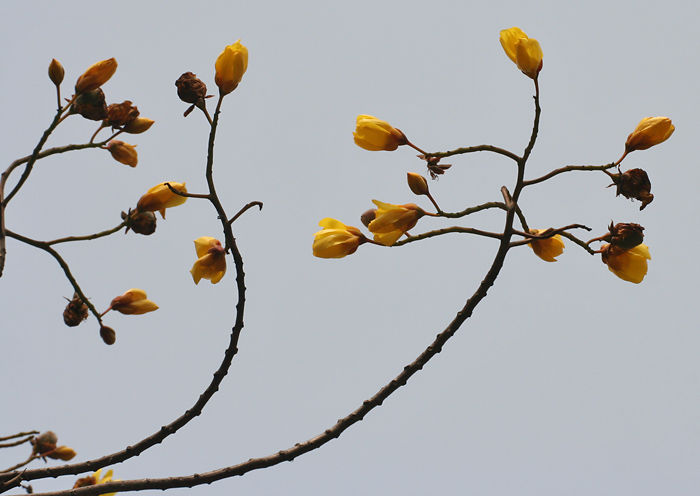
Cochlospermum religiosum is a flowering plant from the tropical region of Southeast Asia and the Indian Subcontinent. It is a small tree growing to a height of 7.5 m usually found in dry deciduous forests. The name religiosum derives from the fact that the flowers are used as temple offerings. It is also known as Silk-Cotton Tree because the capsules containing the seeds have a fluffy cotton-like substance similar to kapok.  Another common name is Buttercup tree because its yellow and bright flowers look like large-sized buttercups. 
In Thailand it is the provincial tree of Nakhon Nayok Province.
File:Yellow Silk Cotton (Cochlospermum religiosum) flowers in Kolkata W IMG 4243.jpg


File:Yellow Silk Cotton (Cochlospermum religiosum) flowering tree in Kolkata W IMG 4252.jpg

Calophyllum inophyllum

Calophyllum inophyllum is a large evergreen, commonly called Alexandrian laurel  balltree,  beach calophyllum, beach touriga,  beautyleaf,  Borneo-mahogany,  Indian doomba oiltree,  Indian-laurel,  laurelwood,  satin touriga,  and tacamahac-tree  It is native from East Africa, southern coastal India to Malesia and Australia.

Calophyllum inophyllum
File:Starr 010309-0546 Calophyllum inophyllum.jpg 

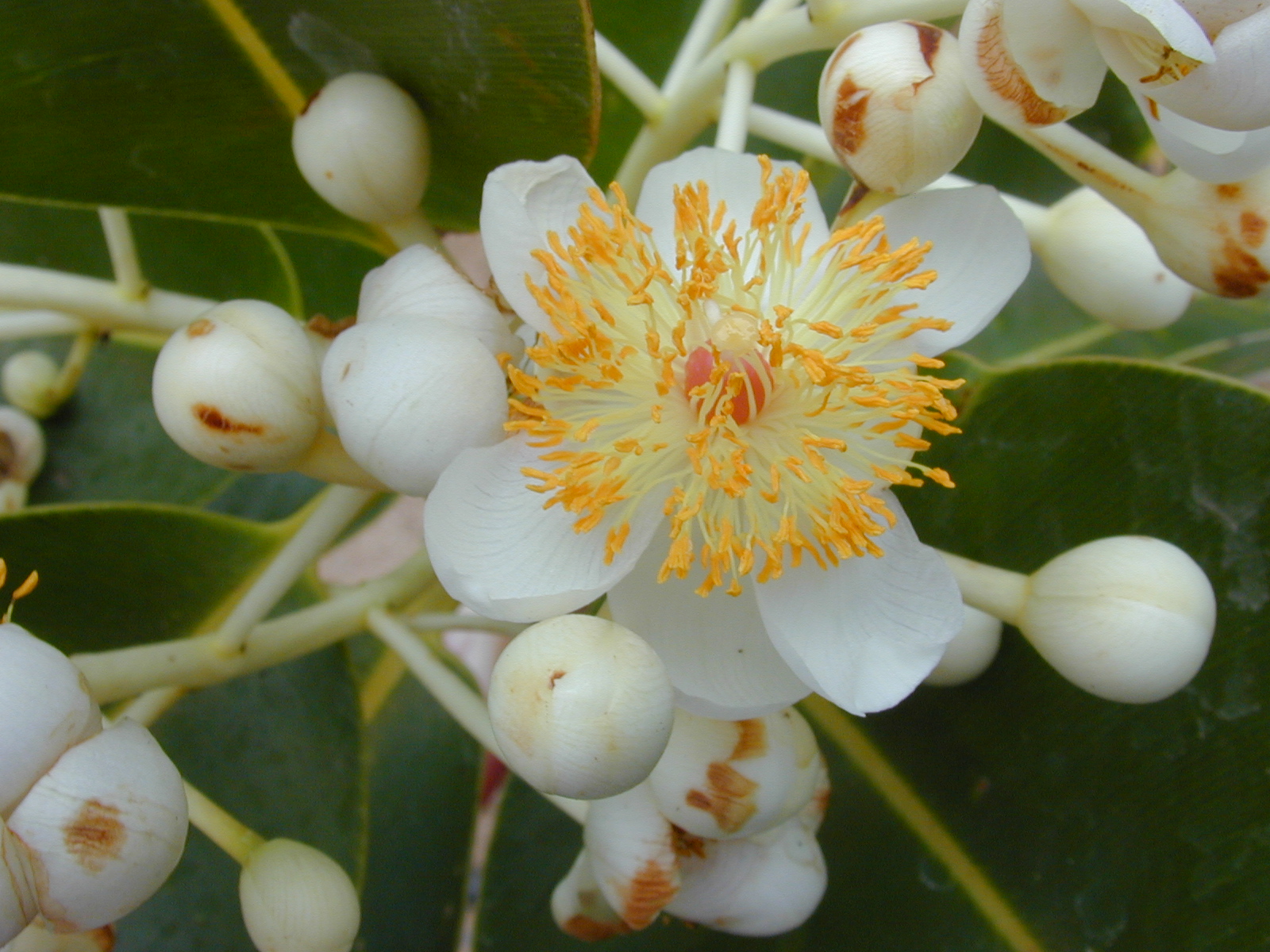
Calophyllum inophyllum is a low-branching and slow-growing tree with a broad and irregular crown. It usually reaches 8 to 20 metres (26 to 66 ft) in height. The flower is 25 millimetres (0.98 in) wide and occurs in racemose or paniculate inflorescences consisting of 4 to 15 flowers. Flowering can occur year-round, but usually two distinct flowering periods are observed, in late spring and in late autumn. The fruit (the ballnut) is a round, green drupe reaching 2 to 4 centimetres (0.79 to 1.6 in) in diameter and having a single large seed. When ripe, the fruit is wrinkled and its color varies from yellow to brownish-red. 

Bretschneidera

Bretschneidera sinensis, the sole species in genus Bretschneidera, is a rare, 10–20 metres (33–66 ft) tall tree with large inflorescences. It is found in south and east of China, Taiwan, northern Thailand and northern Vietnam. It is threatened by habitat loss. Because of its relatively recent discovery in Taiwan and Thailand, it is possible that it could also be found in Laos and northern Myanmar.  It was named in honor of Emil Bretschneider.


 Bauhinia variegata


In Thailand it is known as Chompoo Phu Kha (Thai: ชมพูภูคา) and is found only on Doi Phu Kha National Park in the Luang Prabang Range where it flowers in February and March.

The taxonomic position of genus Bretschneidera is enigmatic, and it has also been placed in its own family, Bretschneideraceae.


Barringtonia asiatica

Barringtonia asiatica (Fish Poison Tree,  Putat or Sea Poison Tree ) is a species of Barringtonia native to mangrove habitats on the tropical coasts and islands of the Indian Ocean and western Pacific Ocean from Zanzibar east to Taiwan, the Philippines, Fiji, New Caledonia, the Cook Islands, Wallis and Futuna and French Polynesia. It is grown along streets for decorative and shade purposes in some parts of India, for instance in some towns on southeastern shore. It is also known as Box Fruit due the distinct box-shaped fruit it produces. The local name futu is the source of the name for the Polynesian island Futuna. The type specimen was collected by botanist Pehr Osbeck on a sandy beach area on the island of Java, later to be described (and given the original name of Mammea asiatica) by Carl Linnaeus in his Species Plantarum in 1753.[3]


Flower


It is a small to medium-sized tree growing to 7–25 m tall. The leaves are narrow obovate, 20–40 cm in length and 10–20 cm in width. Fruit produced as mentioned earlier, is otherwise aptly known as the Box Fruit, due to distinct square like diagonals jutting out from the cross section of the fruit, given its semi spherical shape form from stem altering to a subpyramidal shape at its base. The fruit measures 9–11 cm in diameter, where a thick spongy fibrous layer covers the 4–5 cm diameter seed.

The fruit is dispersed in the same way as a coconut – by ocean current – and is extremely water-resistant and buoyant. It can survive afloat for up to fifteen years;  it was one of the first plants to colonise Anak Krakatau when this island first appeared after the Krakatau eruption. When washed ashore, and soaked by rainwater, the seeds germinate.

All parts of the tree are poisonous, the active poisons including saponins. Box fruits are potent enough to be used as a fish poison. The seeds have been used ground to a powder to stun or kill fish for easy capture,  suffocating the fish where the flesh is unaffected.

Barringtonia asiatica is a common plant in the Malaysian Mangroves and wetlands such as the Kuching wetlands and Bako National Park. Barringtonia asiatica is known locally as Putat laut or Butun.

Its large pinkish-white, pom pom flowers give off a sickly sweet smell to attract bats and moths which pollinate the flowers at night.